
Quick answer:
AI blogs can remain at zero impressions not because their content is low quality, but because the system behind the site never becomes eligible for testing. When automation produces pages without clear intent focus, structural coherence, or reinforcement pathways, search engines have no reason to allocate even initial visibility.

What “Zero Impressions” Actually Means
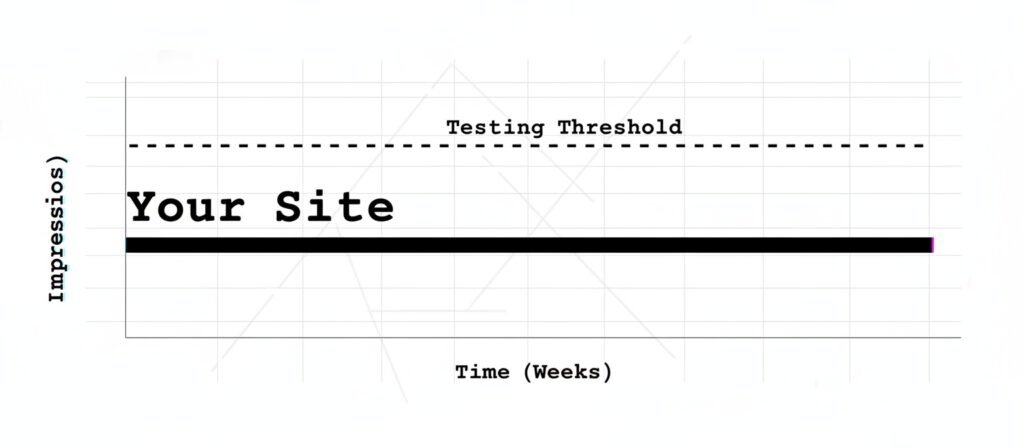
Zero impressions is often interpreted as a ranking failure. In practice, it is a different condition. Ranking implies participation. Impressions imply testing. Zero impressions usually mean that a site is not yet part of the evaluation loop at all.
A page can exist, be crawled, and even be indexed without being actively shown to users. Visibility is not a default state. It is a resource that systems allocate selectively. When a blog shows zero impressions, it is not being rejected in competition; it is being ignored in allocation.
This distinction matters because it changes the nature of the problem. A page that ranks poorly is at least being compared. A page that receives no impressions is not being compared yet. It has not entered the arena where relevance and performance are measured. The failure is not in the outcome but in the eligibility.
For many automated blogs, this state persists because nothing in the system concentrates meaning or priority. Pages exist as isolated outputs rather than as parts of a structure that signals purpose.
A similar allocation dynamic appears when automation encroaches on sites without reinforcement structure, discussed in Why AI Websites Fail After Launch
How Automated Blogs Become Structurally Invisible
Automation excels at producing material. It does not, by default, decide what that material represents.
When content is generated through automated workflows, the system often treats every page as equally valid. Topics are expanded horizontally. Coverage grows outward rather than inward. The site fills with content, but it does not form a clear shape.
Structural invisibility emerges when there is no strong signal of intent. Instead of communicating “this site is about this,” the system communicates “this site contains many things.” From the outside, that looks like abundance. From a selection system’s perspective, it looks like noise.
Visibility systems operate on differentiation. They test content that appears to represent something specific. Automation tends to flatten that specificity. It produces text without producing hierarchy. It fills templates without establishing focus.
Over time, this creates a paradox. The blog becomes larger, but its signal becomes weaker. Each new page adds volume without adding direction. Nothing accumulates. Nothing is reinforced. The system grows, but it does not clarify itself.
This is not a content problem in the usual sense. The text can be readable. The pages can be complete. The design can function. The invisibility arises from a lack of structural intent, not from grammatical or topical errors.
This lack of structural signaling is also connected to indexing-level breakdown examined in: Why AI Content Sites Getting No Index After Publishing

Why These Blogs Never Enter the Testing Phase
Testing requires a reason. Systems that allocate visibility do not test every possible page equally. They look for patterns that suggest relevance, coherence, or emerging importance.
An automated blog often provides none of these. Its pages do not cluster meaningfully. Its topics do not build on each other. Its outputs do not point back to a central question. There is nothing for the system to probe.
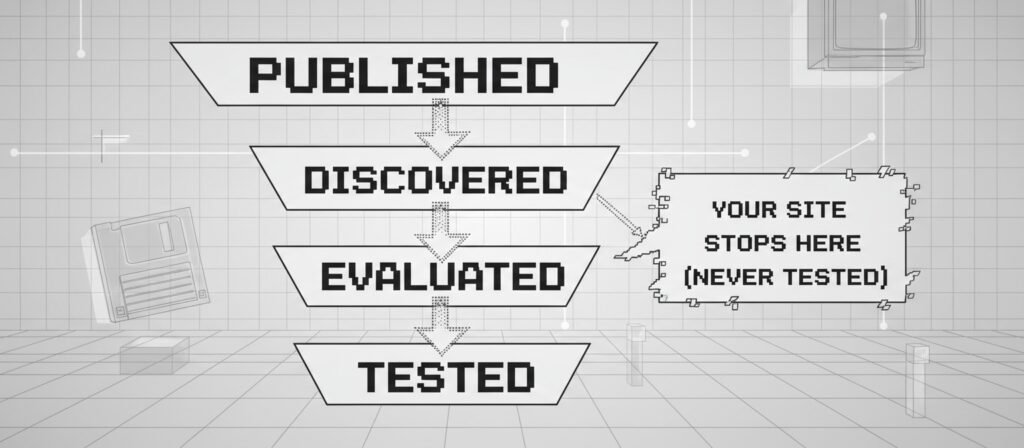
Without concentrated signals, the blog never crosses the threshold from existence to evaluation. It remains in a neutral state: present, but not considered.
This is why many such blogs remain at zero impressions for long periods. It is not because they failed a test. It is because they were never selected for one.
Eligibility is a structural condition. It depends on whether a system can infer purpose and continuity. Automation can generate content without generating that inference. When that happens, the site becomes functionally invisible.
Understanding how automated publishing systems shape these conditions is explored in: How AI Content Automation Actually Works
Why This Is Usually Misread as a Content Problem
When people see zero impressions, they assume something is wrong with the words on the page. They look for flaws in writing, originality, or tone. This is a natural response, because text is what they can see.
Structural absence is harder to perceive. It leaves no obvious trace. There is no error message. There is only silence.
This leads to a misdiagnosis. The blog is treated as if it is being judged and failing. In reality, it is not being judged at all. The system has no clear basis on which to form an opinion.
There is also a psychological reason this misreading persists. Automation produces activity. New pages appear. The system seems to be doing something. That visible motion is taken as evidence of progress. When impressions remain at zero, the contradiction is resolved by blaming the content.
It is easier to believe that a tool produced something “bad” than to recognize that a system produced something undefined.
This misinterpretation pattern often overlaps with feedback loop failures described in AI Content Feedback Loop (SEO)
How This Differs From Sites That Lose Impressions Later
A blog that once had impressions and then lost them is in a different state. That pattern indicates evaluation followed by withdrawal. The system tested the site and reduced its allocation over time.
A blog that never had impressions is not in decline. It is in exclusion.
These two patterns are often conflated. They are described with the same language: “not getting traffic,” “not ranking,” “not working.” But structurally, they are not the same.
One reflects loss of trust. The other reflects absence of eligibility. One implies a history. The other implies that no history has formed.
Treating them as the same problem leads to confusion. It encourages explanations based on competition or change when the real condition is non-entry.
What This Pattern Reveals About Automation
Automation changes the relationship between production and meaning.
In manual systems, each piece of content is usually tied to a decision. Someone chose a topic. Someone had a reason. That reason becomes visible in structure over time.
In automated systems, production can occur without that interpretive layer. The system generates, but it does not explain itself. It fills space without forming direction.
This reveals a limit of automation. It can scale output, but it does not automatically create significance. It can accelerate publishing, but it cannot decide what deserves attention.
When such a system is applied to a domain where selection matters, the result is often invisibility rather than rejection. The system does not fail loudly. It simply never enters the loop where success or failure can occur.
Zero impressions are not a verdict. They are a state. They indicate that the blog has not yet become legible as a subject of evaluation.
This structural invisibility often precedes the ranking decay patterns we’ve documented. Sites that never get tested can’t later lose visibility, but those that receive brief tests before fading follow a different failure path.
FAQs
Q1: Does zero impressions mean the blog is penalized?
No. Zero impressions usually indicate that the blog has not entered the visibility testing phase, not that it has been penalized.
Q2: Can a page be indexed and still get zero impressions?
Yes. Indexing only means the page exists in the system. Impressions require the page to be selected for evaluation and display.
Q3: Is this different from losing traffic after ranking?
Yes. Losing impressions later indicates decline. Zero impressions from the start indicate non-entry into the testing loop.
Q4: Is the problem caused by AI-generated content itself?
Not necessarily. The condition is structural. Automation can publish content without forming the signals required for evaluation.
Q5: Why does this happen more often with automated blogs?
Because automation tends to expand content horizontally without establishing concentrated intent or reinforcement pathways.
Conclusion
An AI blog stuck at zero impressions is not necessarily being punished. More often, it is not being seen as something to test.
This condition arises when automation produces content without producing structure, focus, or continuity. The system speaks, but it does not say what it is about. From the outside, it looks complete. From the inside of a selection process, it looks undefined.
Understanding this reframes the situation. The problem is not that the blog is doing poorly. The problem is that it is not yet participating.
Zero impressions are not a measure of failure. They are a sign of absence from the conversation where failure and success are determined.

Alex Crew, Founder & Lead Analyst
System Analyst at AutomationSystemsLab
Alex founded AutomationSystemsLab after watching too many AI-built websites fail quietly months after launch. He systematically analyzes why AI-driven websites and content automation systems fail — and maps what actually scales for long-term SEO performance. His research focuses on system-level failures, not tool-specific issues.
Diagnostic Mission: To identify automation failure patterns before they become permanent, and provide system-first frameworks that survive algorithm shifts, vendor churn, and market noise. Alex documents observable system behavior, not hype cycles.
EEAT Commitment
- Experience: 3+ years documenting AI automation failure patterns across 500+ sites
- Expertise: System-level analysis of content automation workflows and SEO decay
- Authoritativeness: Referenced by SEO platforms and cited in automation discussions
- Trustworthiness: Full transparency on methodology, funding, and editorial independence
Every analysis published on AutomationSystemsLab follows the Editorial Governor: no affiliate pressure, no vendor influence, just documented system behavior. Alex tracks what breaks, why it breaks at the structural level, and how to build automation that compounds rather than decays.
📍 Connect on LinkedIn