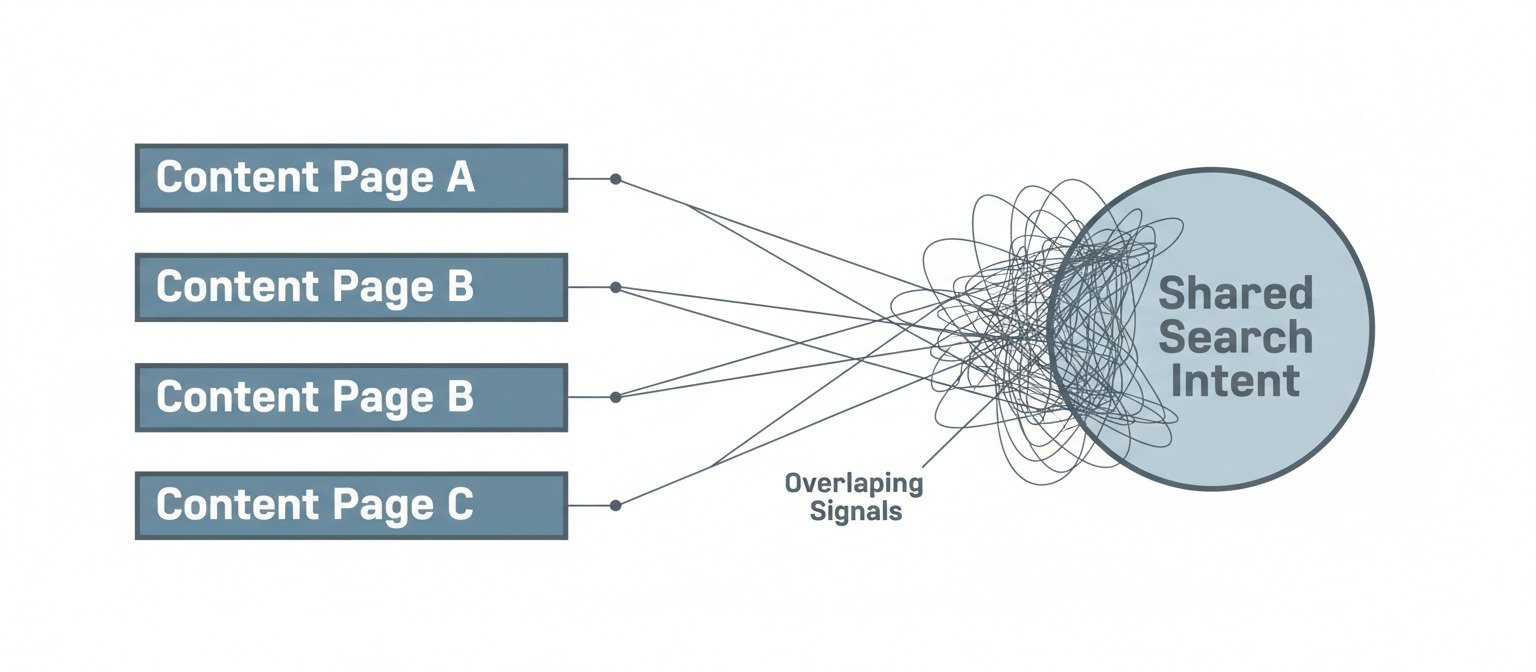
AI content cannibalization issues occur when multiple AI-generated pages unintentionally target the same search intent, causing authority to split instead of consolidate. This problem usually starts at the system and structure level, not at the keyword level. As content scales, overlap grows quietly and visibility becomes unstable.
AI Content Cannibalization Issues
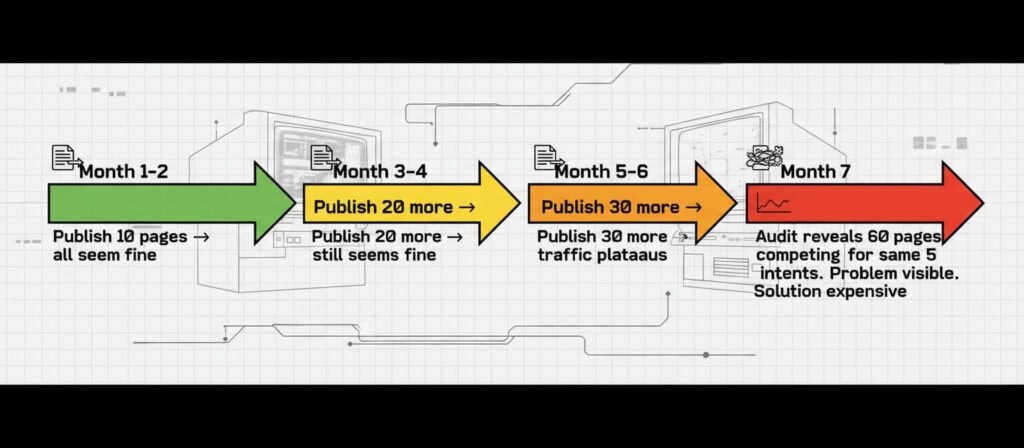
AI Content Cannibalization Issues often appear when websites keep publishing content, but visibility and authority never settle in one place. Pages get indexed. Articles go live. Traffic graphs stay flat or become unstable over time.
Most people view this as a keyword problem. Field experience suggests something else. AI content cannibalization issues usually start before keywords become a problem. They originate inside the publishing system itself, not only inside search results.
This article explains AI content cannibalization issues as a mechanism-level system behavior, not as a simple SEO mistake.
What Content Cannibalization Is Commonly Assumed to Be
Most explanations describe content cannibalization in familiar terms:
Multiple pages target the same keyword
Rankings fluctuate
Search engines cannot choose a clear winner
Authority gets divided across URLs
This description is not wrong. It is incomplete.
It describes what happens, not why it happens.
That is why many AI-driven websites continue publishing after launch but never reach stable growth. This pattern appears even on technically sound sites. We observed similar behavior while analyzing why AI websites fail after launch despite consistent publishing.
Why AI-Generated Content Is More Prone to Cannibalization
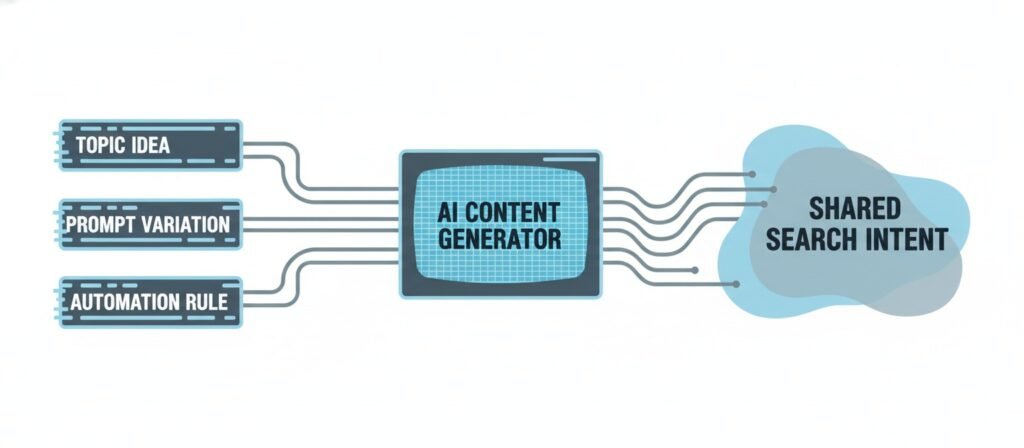
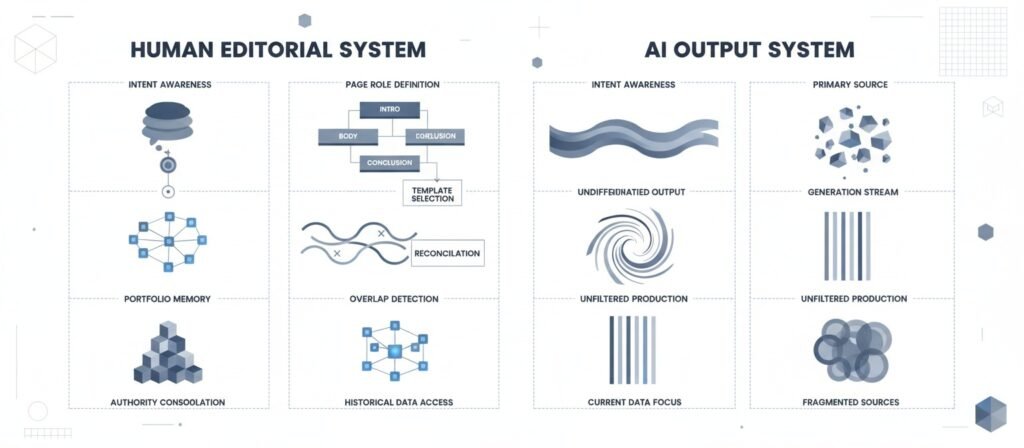
AI content cannibalization issues are more common in systems with heavy automation. AI tools treat each prompt as a new opportunity. The system usually has no awareness of:
Which intent is already covered
Which page owns which role
Where internal overlap already exists
AI writes. The system does not decide.
This difference becomes clearer when separating AI writing vs. content systems. Writing produces text. Systems allocate intent and authority.
When intent allocation is missing, cannibalization becomes likely.
The Intent Replication Mechanism
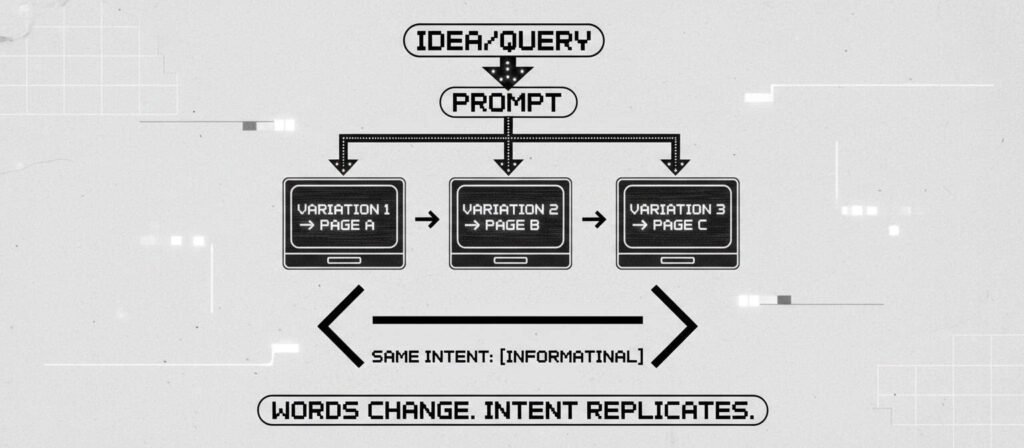
The core driver behind AI content cannibalization issues is intent replication.
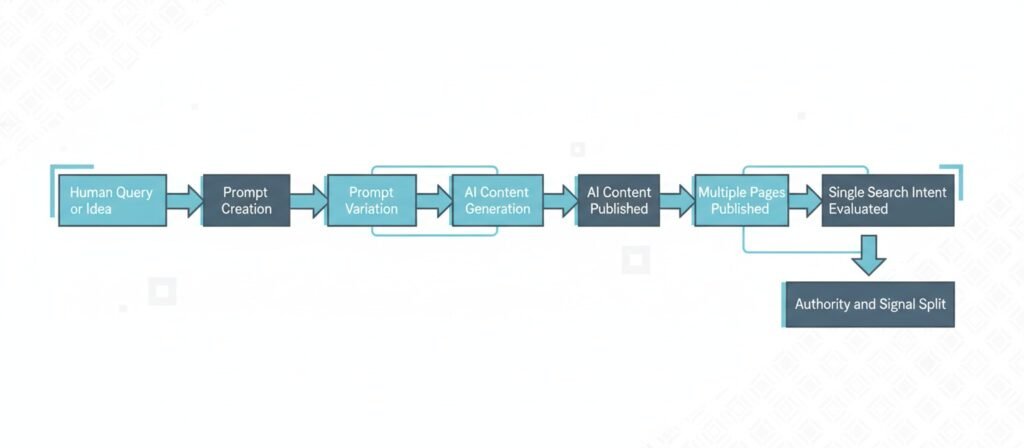
This workflow appears repeatedly across AI publishing systems:
A human idea or query is identified
The idea is converted into a prompt
Prompt variations are created
AI generates a new page for each variation
The wording changes. The intent usually does not.
What actually replicates
Layer
Changes
Stays the same
Words
Yes
No
Structure
Sometimes
Often
Search intent
No
Always
User expectation
No
Always
Cannibalization starts here. Before ranking. Before indexing.
This explains why many AI blogs remain stuck at zero impressions even when the content looks fine.
Intent vs Page Role Collision
Multiple pages appear distinct at the topic level but collapse into the same search intent at evaluation time.
Page URL
Primary Topic
Intended Role
Actual Search Intent
Collision Type
Page A
AI content scaling
Explainer
Informational
Direct overlap
Page B
AI content issues
Analysis
Informational
Role duplication
Page C
AI SEO problems
Overview
Informational
Intent convergence
Structural Blindness in Automated Content Systems
Most AI publishing pipelines miss one critical layer. Structural awareness.
These systems often lack:
A global intent map
Defined page roles
Exclusion rules
Conflict detection
Human editors sense overlap naturally. Automated systems require explicit structure.
When this layer is missing, the system cannot evaluate its own output. The content portfolio slowly fills with overlapping pages.
Where intent is unmanaged, AI content cannibalization issues naturally emerge.
People Also Ask:
What is the problem with AI-generated content?
The most common problems show up when AI output is published at scale without strong editorial structure. You often see overlap between pages, weak differentiation, shallow sourcing, and inconsistent factual reliability. Over time, this can reduce trust signals and make it harder for search systems to treat any one page as the clear best answer.
What is content cannibalization?
Content cannibalization happens when multiple pages on the same site compete for the same search intent. Instead of one strong page accumulating signals, several similar pages split relevance, links, and engagement. The result is often unstable rankings, rotating URLs, or weaker overall visibility.
What is the 30% rule in AI?
There is no single, universal “30% rule in AI” that is broadly accepted across the industry. People use “30%” in different contexts, such as internal editorial heuristics, compliance thresholds, or content change guidelines. If you saw it in a specific tool, policy, or course, the meaning depends on that source’s definition.
What are the problems with AI content moderation?
AI moderation can struggle with context, sarcasm, regional language, and fast-changing cultural references. It may also produce false positives, false negatives, and inconsistent enforcement across similar cases. These issues become more visible when moderation decisions are automated at high volume without clear escalation and review paths.
TechTarget AI cannibalism explained: a model failure
The Week AI is cannibalizing itself. And creating more AI.
These sources are provided to validate observed patterns around content overlap, intent ambiguity, authority dilution, and recursive system behavior. They support the analysis without defining or constraining the system-level interpretation presented in this article.
Alex Crew, Founder & Lead Analyst
System Analyst at AutomationSystemsLab
Alex founded AutomationSystemsLab after watching too many AI-built websites fail quietly months after launch. He systematically analyzes why AI-driven websites and content automation systems fail — and maps what actually scales for long-term SEO performance. His research focuses on system-level failures, not tool-specific issues.
Diagnostic Mission: To identify automation failure patterns before they become permanent, and provide system-first frameworks that survive algorithm shifts, vendor churn, and market noise. Alex documents observable system behavior, not hype cycles.
EEAT Commitment
Experience: 3+ years documenting AI automation failure patterns across 500+ sites
Expertise: System-level analysis of content automation workflows and SEO decay
Authoritativeness: Referenced by SEO platforms and cited in automation discussions
Trustworthiness: Full transparency on methodology, funding, and editorial independence
Every analysis published on AutomationSystemsLab follows the Editorial Governor: no affiliate pressure, no vendor influence, just documented system behavior. Alex tracks what breaks, why it breaks at the structural level, and how to build automation that compounds rather than decays.