
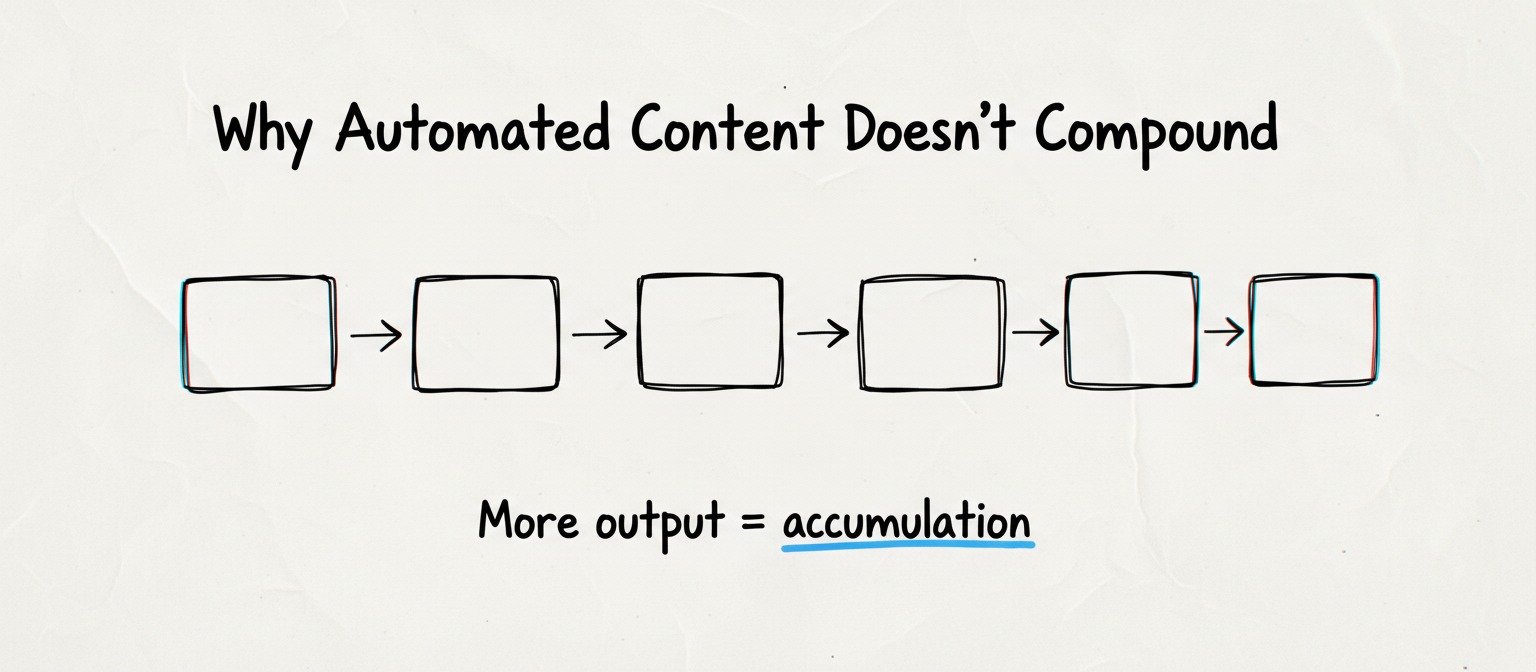
Why Automated Content Doesn’t Compound
Quick Answer
Automated content does not compound because it produces isolated outputs without reinforcement, memory, or differentiation. Compounding requires signals to strengthen over time through reuse and consolidation. Automation usually increases volume, but it rarely creates accumulation, which is why growth stays linear instead of exponential.
Introduction:
Why automated content doesn’t compound is a question many site owners ask after months of consistent publishing. Articles go live on schedule. Pages get indexed. Dashboards show activity. Yet authority, traffic, and trust do not grow in a cumulative way.
This problem is often blamed on content quality, tools, or algorithms. Field observation suggests something else. Automated content usually fails to compound because compounding is not a production effect. It is a system behavior.
This article explains why automated content doesn’t compound by focusing on accumulation, reinforcement, and structure rather than tactics or fixes.
The Compounding Expectation
Automation is often sold with a simple promise. Publish more, faster, and results will stack over time. This idea borrows language from finance, where compounding works because gains are reinvested into the same system.
In content systems, that assumption quietly breaks.
Many teams observe the same pattern. Publishing feels productive, but long-term value stays flat. This gap becomes visible in cases where AI websites fail after launch despite steady output.
The expectation is compounding. The reality is accumulation never starts.
What Compounding Actually Means in Content
Compounding in content does not mean publishing more pages.
It means:
- Signals reinforce previous signals
- Authority concentrates instead of spreading
- New work strengthens existing assets
- The system remembers what already worked
In other words, compounding requires memory and reuse.
A system that treats every new article as a fresh start cannot compound. It can only produce.
Why Automated Content Feels Productive but Stalls
Automation creates motion. Motion feels like progress.
Each new article adds:
- A new URL
- A new timestamp
- A new piece of text
What it often does not add is cumulative strength.
From the outside, activity increases. From the system’s perspective, each page competes for attention on its own. This is why many AI blogs appear active but remain invisible, a pattern explored in why AI blogs get stuck at zero impressions.
The Output vs Accumulation Gap
This gap explains why automated content doesn’t compound.
Output and accumulation are not the same thing
Dimension | Output | Accumulation |
Focus | New pages | Strengthening signals |
Direction | Forward only | Layered over time |
Memory | None | Persistent |
Effect | Activity | Authority |
Growth pattern | Linear | Compounding |
Automation excels at output. Compounding requires accumulation. Without a mechanism that feeds value back into existing signals, content remains isolated.
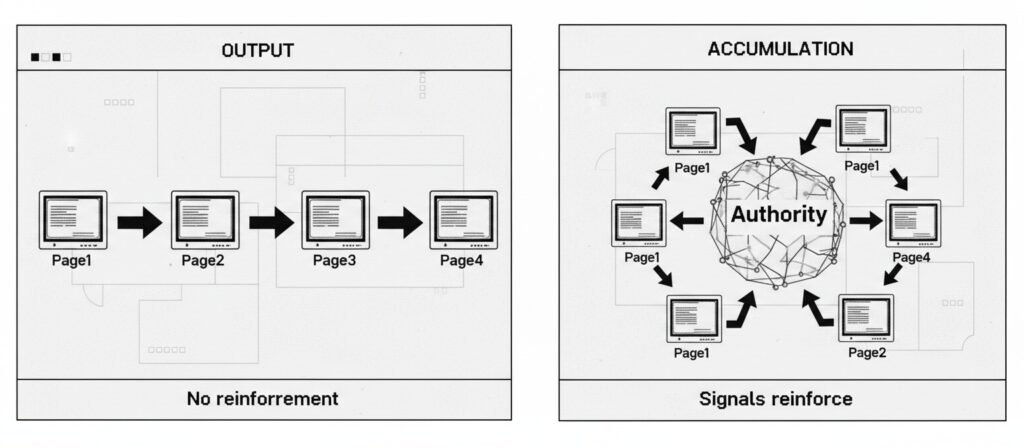
Automation Without a Reinforcement Loop
Most automated publishing systems follow a simple flow:
- Generate content
- Publish content
- Move on to the next item
There is no structured return path where signals reinforce earlier work.
This behavior is visible in systems where pages get published but never stabilize, a pattern discussed in how AI content automation actually works.
Typical automated loop
- Prompt generates text
- The page is published
- The system advances to next prompt
What is missing:
- Signal interpretation
- Role persistence
- Reinforcement of past pages
Without a reinforcement loop, compounding cannot occur.
Equivalence Collapse at Scale
As automation scales, another issue emerges. Everything starts to look equally good.
Reddit discussions often describe this as content blending into one voice. Not because it is bad, but because it is indistinguishable.
When all pages meet the same baseline quality:
- No page stands out
- No signal concentrates
- No asset becomes dominant
This equivalence collapse explains why scale often reduces impact. It also connects directly to why automated content doesn’t compound. Compounding requires differentiation. Equivalence prevents it.

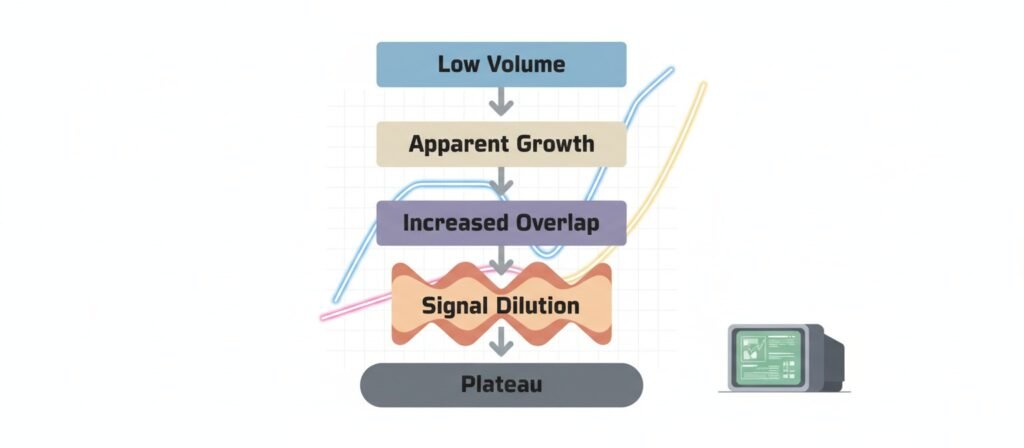
Why Volume Plateaus Instead of Compounding
Early results can be misleading.
At low volume:
- Each new page adds marginal visibility
- Competition is limited
- Signals appear to grow
As volume increases:
- Internal competition rises
- Signals flatten
- Marginal gains shrink
This plateau is frequently misdiagnosed as an algorithm issue when it is actually a structural one. Similar behavior appears in cases where AI content sites get no index after publishing.
The system keeps producing, but accumulation never accelerates.
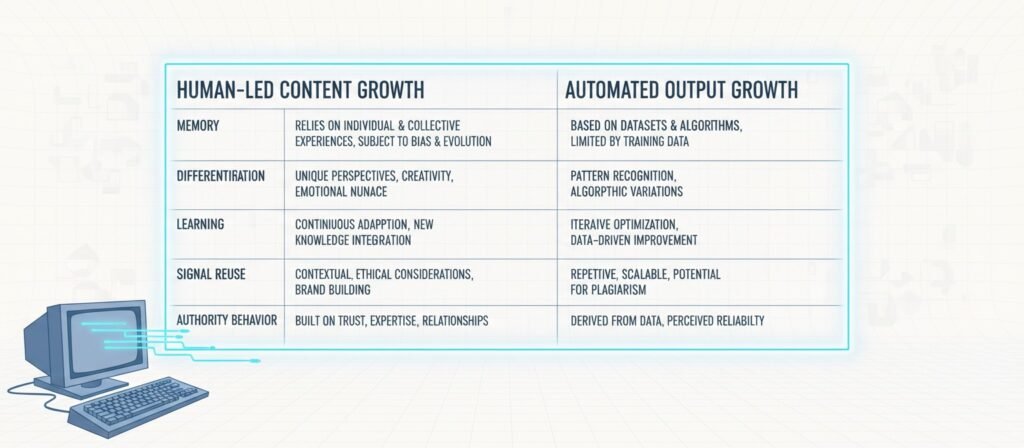
Human Content Growth vs Automated Output Growth
Human-led content systems behave differently over time.
Aspect | Human-Led Growth | Automated Output |
Learning | Accumulates | Resets |
Differentiation | Increases | Flattens |
Signal reuse | High | Low |
Memory | Persistent | Minimal |
Authority | Concentrates | Disperses |
This difference explains why automation alone struggles to compound authority. It also connects to the distinction explored in AI writing vs content systems.
Why This Problem Appears Late
One reason why automated content doesn’t compound is missed early timing.
In early stages:
- Volume is low
- Conflicts are minimal
- Signals appear clean
As content grows:
- Overlap increases
- Competition becomes internal
- Accumulation stalls
By the time the issue is visible, many pages already exist. This delayed realization mirrors patterns seen when AI websites stop ranking after initial traction. The failure is gradual, not sudden.
What This Article Does Not Cover
To avoid overlap and confusion, this article intentionally does not cover:
- How to fix automated content
- Tools or workflows
- Best practices or strategies
- Human-in-the-loop frameworks
Those topics dominate the SERP. This article focuses only on mechanism and behavior.
Frequently Asked Questions:
Why can’t content strategy be automated?
Content strategy involves intent decisions that depend on context, trade-offs, and priorities across many pages. Automation can generate outputs, but it usually cannot reliably assign page roles, resolve overlaps, or decide what not to publish. Strategy tends to require judgment about focus, differentiation, and long-term positioning.
What are the disadvantages of automatic processing?
Automatic processing can scale speed, but it often reduces awareness of context and exceptions. Common disadvantages include repeated outputs, weak differentiation, error propagation, and decisions made without feedback interpretation. In content systems, this can show up as overlap, unstable visibility, and diluted authority rather than cumulative growth.
What are the 4 pillars of automation?
There is no single universal model, but a common way to describe automation pillars is
- Process: the workflow being automated
- Technology: tools and infrastructure enabling it
- People: ownership, oversight, and accountability
- Governance: rules, quality control, and risk handling
Different industries may label these pillars differently, but the core idea is that automation is not only software. It is also management and control.
Will content writing be automated?
Some parts of content writing are already automated, especially drafting, summarizing, formatting, and repurposing. Full automation of effective content writing is less certain because strong content often depends on original experience, accurate sourcing, and intent-aware structure across a site. In practice, many teams use automation for production while keeping key decisions human-led.
How Cannibalization Connects to Compounding Failure
When automated systems produce many pages without role clarity, overlap becomes inevitable. Signals split instead of reinforcing. This behavior directly links to AI content cannibalization issues, where authority disperses across similar assets.
Cannibalization is not a separate problem. It is one of the ways compounding fails to emerge.
This same dynamic explains why autoblogging destroys topical authority over time.

References
Google Search Central
Creating helpful, reliable, people-first content
https://developers.google.com/search/docs/fundamentals/creating-helpful-contentGoogle Search Central
Spam policies for Google web search
https://developers.google.com/search/docs/essentials/spam-policiesKevin Indig
The diminishing returns of content velocity
https://www.kevin-indig.com/the-diminishing-returns-of-content-velocity/Towards Data Science
The automated content conundrum
https://towardsdatascience.com/the-automated-content-conundrum-6f7c9e7e0a9eHarvard Business Review
Why more data does not always mean better decisions
https://hbr.org/2018/02/why-more-data-does-not-always-mean-better-decisions
Conclusion
Why automated content doesn’t compound is rarely a matter of tools, effort, or intent. It is primarily a question of structure.
Automation is effective at increasing production. Compounding, however, depends on accumulation. It requires signals to persist, reinforce one another, and concentrate over time. When those conditions are absent, content exists as a sequence of independent outputs rather than as a growing asset.
In such systems, growth remains linear. Authority does not consolidate. The appearance of scale masks the absence of reinforcement.
Compounding is not an automatic outcome of publishing more. It emerges only when systems are designed to build on what already exists. Without that design, automated content remains productive, but it does not compound.

Alex Crew, Founder & Lead Analyst
System Analyst at AutomationSystemsLab
Alex founded AutomationSystemsLab after watching too many AI-built websites fail quietly months after launch. He systematically analyzes why AI-driven websites and content automation systems fail — and maps what actually scales for long-term SEO performance. His research focuses on system-level failures, not tool-specific issues.
Diagnostic Mission: To identify automation failure patterns before they become permanent, and provide system-first frameworks that survive algorithm shifts, vendor churn, and market noise. Alex documents observable system behavior, not hype cycles.
EEAT Commitment
- Experience: 3+ years documenting AI automation failure patterns across 500+ sites
- Expertise: System-level analysis of content automation workflows and SEO decay
- Authoritativeness: Referenced by SEO platforms and cited in automation discussions
- Trustworthiness: Full transparency on methodology, funding, and editorial independence
Every analysis published on AutomationSystemsLab follows the Editorial Governor: no affiliate pressure, no vendor influence, just documented system behavior. Alex tracks what breaks, why it breaks at the structural level, and how to build automation that compounds rather than decays.
📍 Connect on LinkedIn