
Quick Answer
AI website builders make sense when the website is treated as a bounded digital asset rather than a scalable digital infrastructure. They align best with fast launches, stable requirements, minimal integrations, and low dependency risk. Their fit weakens as system complexity, SEO control needs, and long-term scalability increase.
What Is an AI Website Builder?
An AI website builder is a platform that uses automated layout generation, content suggestions, and template systems to create a functional website with minimal manual configuration. It reduces production friction but does not automatically manage long-term architecture, integrations, or strategic positioning.
This distinction matters.
Many discussions about AI website builders focus on design quality. In practice, the more important variable is system behavior over time.
Introduction
AI website builders trigger strong reactions. Some people believe they eliminate web designers. Others dismiss them as low-quality shortcuts.
From observing real deployments across small businesses, portfolio sites, and early-stage projects, I’ve noticed something different. The success or failure of an AI-built website rarely depends on the tool itself. It depends on how the website is expected to function as part of a broader digital system.
The question is not whether AI website builders work.
The question is whether they fit your structural requirements.
This system-level view aligns with our framework in how Google evaluates AI content systems—evaluation targets system behavior, not tool choice.
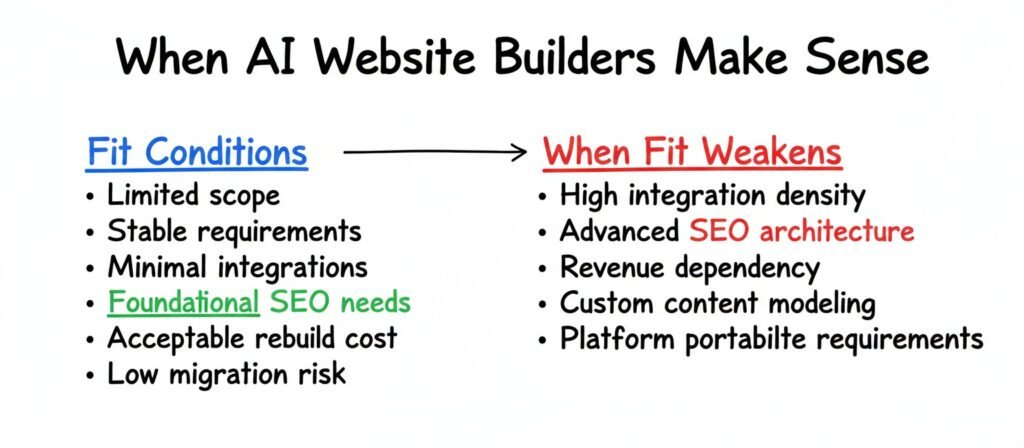
When AI Website Builders Make Sense (Summary List)
AI website builders are usually appropriate when:
- The website has limited scope
- Requirements are stable or generic
- Integrations are minimal
- SEO demands are foundational rather than advanced
- Rebuilding later is acceptable
- Long-term platform portability is not critical
They become less appropriate as integration density, SEO control requirements, and revenue dependency increase.
When these conditions are ignored, the result is often the post-launch decline we documented in why AI websites fail after launch.
The Promise Is Real—But It’s Production-Level
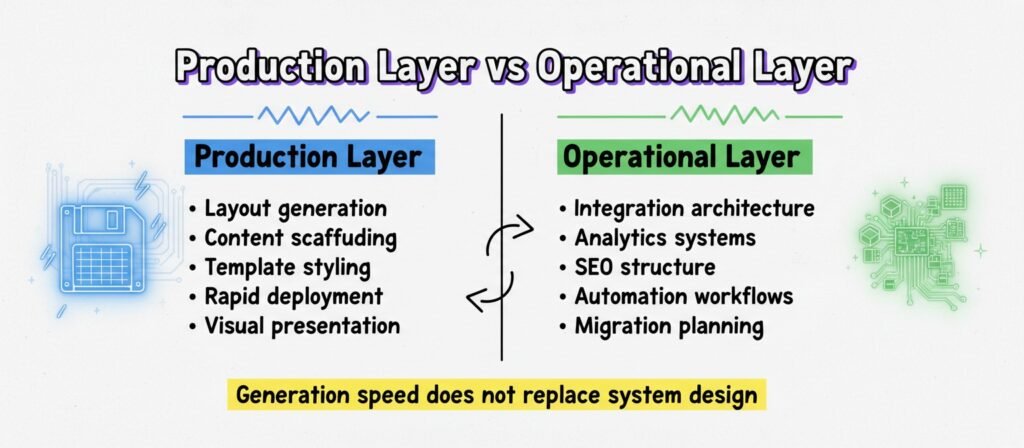
AI website builders reduce friction. They generate layouts, structure pages, write placeholder content, and deploy hosting quickly.
For a small business website, portfolio site, or MVP launch, that speed can be valuable. In early validation stages, reducing time-to-launch often matters more than architectural perfection.
However, speed operates at the production layer. It does not replace operational planning.
Artifact vs System: The Structural Distinction
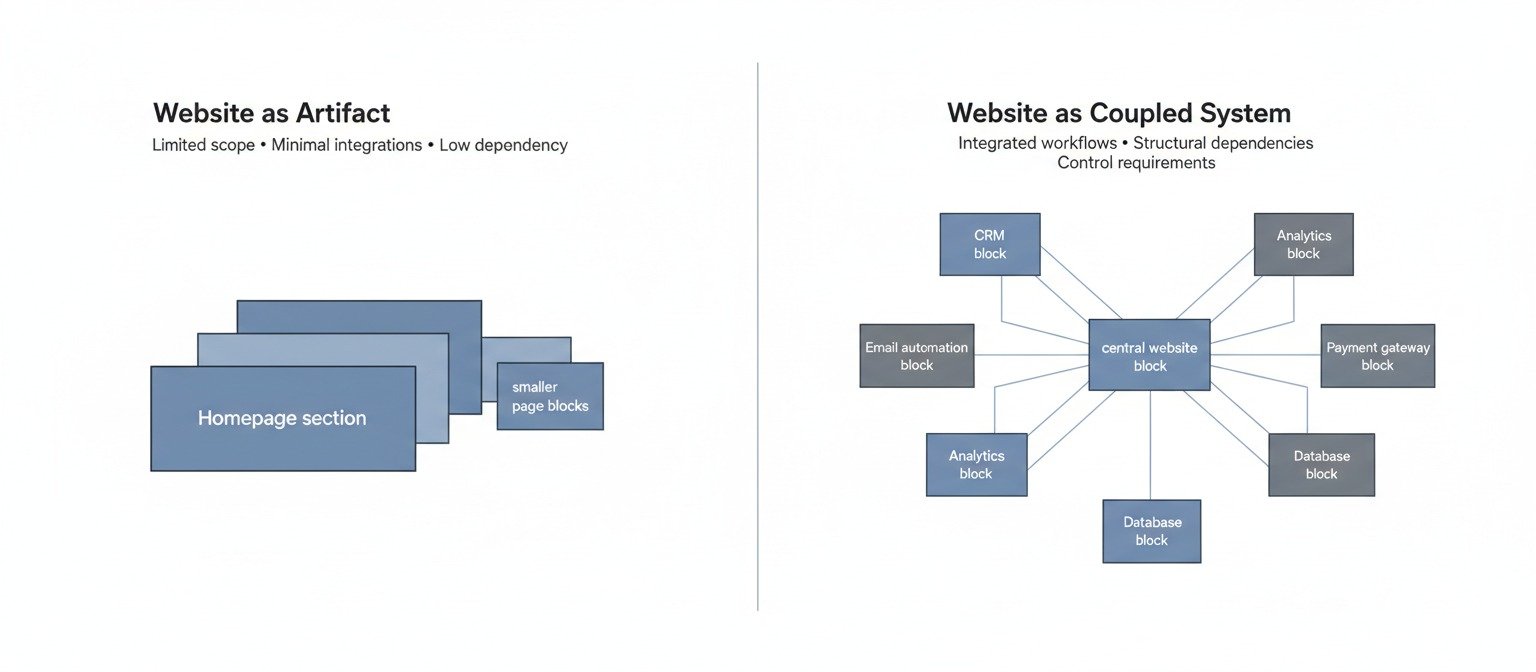
I consistently separate websites into two structural categories:
- Website as artifact
- Website as coupled system
This distinction clarifies when AI website builders work — and when they don’t.
Website as Artifact
An artifact-based website:
- Exists primarily for credibility
- Has limited integrations
- Rarely changes structure
- Does not depend on advanced SEO architecture
- Does not require layered automation
In this case, an AI website builder for small business use often makes complete sense. The site behaves like a digital brochure. Rebuilding later carries minimal risk.
This low-risk profile explains why artifact-based sites rarely experience the compounding failures analyzed in why automated content doesn’t compound—there’s no system to compound.
This distinction is central to whether you should trust AI website builders for your specific use case. Artifact-based sites have very different trust requirements than system-based ones.
Where AI Website Builders Begin to Break
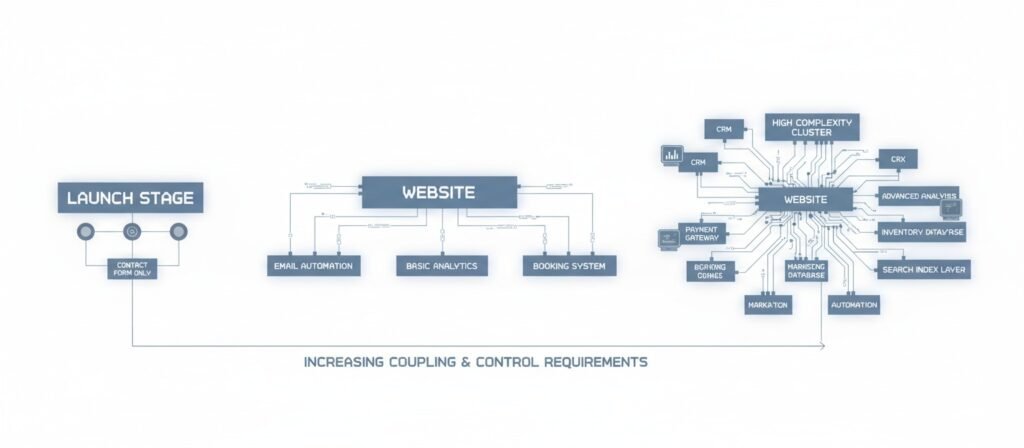
They rarely fail immediately. Friction accumulates gradually.
1. Integration Density Increases
Each additional integration multiplies dependencies. Booking logic, CRM connections, marketing automation, and tracking scripts increase structural coupling.
AI builders often abstract these layers. Abstraction simplifies early setup. It can limit later flexibility.
This limitation is a specific manifestation of the hidden control problems we’ve documented—abstraction simplifies early setup but constrains later flexibility.”
2. SEO Control Requirements Expand
Most AI website builders support basic SEO settings:
- Meta titles
- Descriptions
- Responsive layouts
However, advanced SEO often requires:
- Controlled URL architecture
- Internal linking systems
- Schema customization
- Performance optimization control
When SEO strategy becomes architecture-dependent, limitations can emerge.
When SEO strategy expands beyond foundational controls, you need a clear evaluation framework to assess whether a platform can grow with your requirements.”
3. Platform Lock-In Becomes Visible
Early-stage projects rarely worry about migration risk. Later-stage projects often do.
Export limitations, proprietary templates, and URL restructuring constraints can introduce friction during platform transitions.
This friction often prevents the structural corrections needed to fix the patterns we documented in AI content cannibalization issues—if you can’t restructure, you can’t resolve intent overlap.
This is not inherently good or bad. It is a structural trade-off.

The Mispricing Illusion Around AI
AI website builders change perception.
Because output appears quickly, observers often assume the work is trivial. In reality, even AI-generated websites still require:
- Hosting configuration
- Domain management
- Analytics implementation
- Performance validation
- Layout refinement
- Integration debugging
AI reduces generation effort. It does not eliminate system responsibility. This perception gap explains many pricing conflicts in the market today.
This perception gap explains why vendors don’t tell you about the ongoing responsibility that comes with AI-generated sites—it’s harder to sell maintenance than speed.
Common Misinterpretations
Fast Launch Equals Scalability
Launch speed does not guarantee structural extensibility. This misconception drives the pattern we observed in why AI websites fail after launch—sites built for speed, not for evolution.
Visual Quality Equals Strategic Effectiveness
Clean design does not automatically translate into conversion optimization or organic search performance.
AI Generation Equals Strategic Judgment
AI can generate content and layout suggestions. It does not define long-term digital strategy, positioning, or architectural trade-offs.
Frequently Asked Questions
Are AI website builders worth it?
They are worth it when the website serves as a bounded online presence with limited integrations and modest SEO requirements. They may be less suitable when the site functions as a revenue-critical digital system.
Do AI website builders work for SEO?
They support foundational SEO features such as metadata control and mobile responsiveness. Advanced SEO performance depends on how much architectural control the platform provides.
Can AI replace web designers or developers?
AI tools assist production. They do not automatically replace strategic planning, integration design, or system-level decision-making.
External Resources & Further Reading
The following sources informed broader market framing and comparison patterns:
- Wix—How does an AI website builder work
https://www.wix.com/blog/how-does-an-ai-website-builder-work - WPBeginner—Are AI Website Builders Worth The Hype?
https://www.wpbeginner.com/opinion/are-ai-website-builders-worth-the-hype/ - Austin Web & Design—AI Website Builders vs Web Designers
https://austinwebanddesign.com/ai-website-builders-vs-web-designers/ - AJ Oberlender—I Asked AI to Build a Website
https://www.ajoberlender.com/blog/i-asked-ai-to-build-a-website - SiteW—AI website builder, what are they really worth?
https://www.en.sitew.com/artificial-intelligence/ai-site-builder
Conclusion:
In the end, AI website builders make sense when expectations align with structural reality. When treated as bounded artifacts, they perform well. When treated as fully adaptable revenue systems without architectural planning, friction emerges. The decision, therefore, is not about hype or fear. It is about system design and constraint awareness.
Even when builders make sense for your current needs, watching for signs of overselling helps ensure you’re not being sold capabilities that won’t materialize as your site evolves.

Alex Crew, Founder & Lead Analyst
System Analyst at AutomationSystemsLab
Alex founded AutomationSystemsLab after watching too many AI-built websites fail quietly months after launch. He systematically analyzes why AI-driven websites and content automation systems fail — and maps what actually scales for long-term SEO performance. His research focuses on system-level failures, not tool-specific issues.
Diagnostic Mission: To identify automation failure patterns before they become permanent, and provide system-first frameworks that survive algorithm shifts, vendor churn, and market noise. Alex documents observable system behavior, not hype cycles.
EEAT Commitment
- Experience: 3+ years documenting AI automation failure patterns across 500+ sites
- Expertise: System-level analysis of content automation workflows and SEO decay
- Authoritativeness: Referenced by SEO platforms and cited in automation discussions
- Trustworthiness: Full transparency on methodology, funding, and editorial independence
Every analysis published on AutomationSystemsLab follows the Editorial Governor: no affiliate pressure, no vendor influence, just documented system behavior. Alex tracks what breaks, why it breaks at the structural level, and how to build automation that compounds rather than decays.
📍 Connect on LinkedIn